


EXIT is a fraternity dedicated to shorting managerial systems and building the human institutions that come next. Learn more here:
Over the last two years, NatalCon has conclusively won the argument.
In 2023, the idea that depopulation, not overpopulation, was the world’s most pressing demographic problem, was an eccentric, contrarian take.
Many middle-aged female journalists regarded it as so eccentric, in fact, that it couldn’t be a serious position — surely it was merely cover for a right-wing plot to seize the government and forcibly impregnate middle-aged female journalists.
NatalCon 2023 was very much an inside thing: we were joined by brave, contrarian academics, but very little media coverage, except to talk about how dangerous and far-right it was to want people to start families.
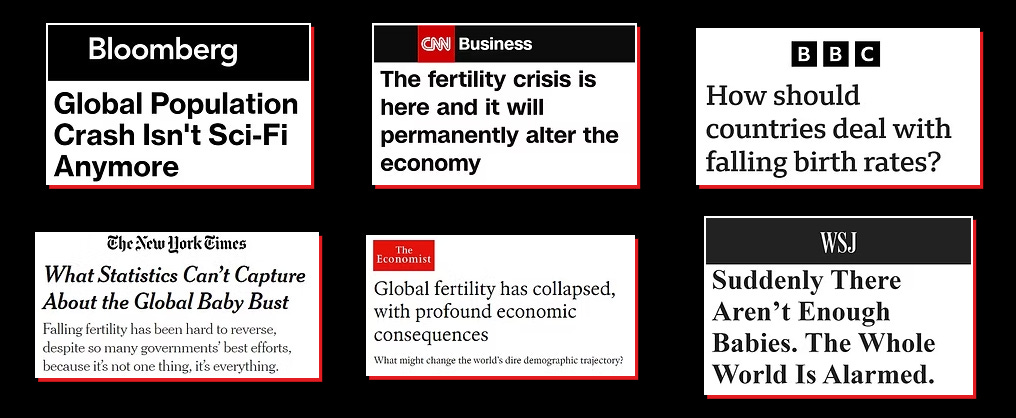
But in the months thereafter, things started to turn: they didn’t mention the conference, but the headlines were radically different. It wasn’t a far-right extremist fever dream anymore — now it was a legitimate issue, unfortunately co-opted by far-right extremists.
(We stole this issue, you see, from the libtards to whom it rightly belongs, by caring about it before they did.)
NatalCon 2025 brought in pretty much every mainstream academic making a serious study of this issue.
We had middle-aged female journalists literally trying to wrestle their way in past security (brave of them, if you think about it) — the conference was covered by CNN, the New York Times, NPR, The Atlantic, the BBC, the Economist.
The coverage was still mostly fantasizing about our hidden, wicked motivations — but they were no longer talking about us like a flat-earth convention.
Now the problem was obviously mainstream, obviously respectable academics sharing a stage with the likes of Jack Posobiec. Disparate (and sometimes hostile) factions of the Right, from Steve Bannon to Elon Musk to JD Vance, were all talking about this issue.
Even Bronze Age Pervert, who initially dismissed the problem out of hand, has clearly been chewing on it for over a year, is now coming up with characteristically inventive solutions.
Every major conservative think tank and policy shop is now standing up a department to think and talk (and think, and talk) about this issue. The taboo on natalism in academia has been broken, with tenured professors across multiple disciplines working openly on this issue and discussing their findings directly, without intermediary institutions.
Several articles asked, hilariously, if there shouldn’t be an attempt at “left-wing natalism” to flank the far right, and prevent them from monopolizing the rhetorical position that human life is good and should continue.
(Needless to say, leftists are incapable of even mouthing those words.)
So we won — but there’s not that much left to say, really, about The Data.
Nobody seriously disputes that demographic collapse is happening, or that it presents an existential problem for every developed nation on earth.
We successfully delivered that case to the President of the United States, the richest man on earth, and every essential node of the pro-family think-tank and non-profit complex.
Everything that could be accomplished by showing policymakers line graphs pointed in the wrong direction has been accomplished.
We started NatalCon with a lot of “epistemic humility” — we wanted to cover the issue comprehensively, with as many smart people as we could find, delivering as many angles as possible.
But what we learned, basically, is this:
Demographic collapse is going to destroy the managerial systems that cause it,
There’s very little that can be done about it until those systems fail,
We wouldn’t want the managerial solutions to work, even if we thought they could.
Demographic collapse is the good news.
Falling in love and having babies is among the most natural and powerful impulses a human being can have. If billions of people are just vaguely saying they “don’t feel like it”, something has gone profoundly wrong, and the appropriate response is not a symptomatic policy band-aid.
If you find yourself trying to justify or sell this basic human imperative, as one lifestyle choice among many, or as a vehicle for delivering some other good — or, God forbid, as a means of wringing a few more years out of a decrepit and exhausted system — you’ve already lost.
People aren’t having babies because the system they live within is profoundly unnatural and anti-human, and it needs to fail.
Trying to make people breed in order to save that system is precisely backwards. The only good reason to care about the economy, or the budget deficit, or house prices, or the state of the military, is because those factors either support, or suppress — or, worst of all, derange — healthy family formation.
Demographic collapse tells us that human society can’t just infinitely circle the drain: the people capable of running the machinery may be willing to live as psychically gelded interchangeable productivity units, but they aren’t willing to breed that way.
This means that the processes that generate our present predicament really are self-terminating — which is very good news.
So why keep talking about demographic collapse at all?
For at least two reasons.
First: Demographic collapse will not self-terminate gently, like a thermostat.
This is many people’s first response to hearing that underpopulation is a crisis: “Well, there are already too many people, so we’ll just die off until there are fewer of us, and then things will get better, and people will start having kids again.”
We are losing not just interchangeable people at random, but specifically (for obvious reasons) we are losing the young, vibrant, and healthy — and, for less-obvious reasons, we are also disproportionately losing the conscientious, the productive, the ambitious, the responsible, the mentally stable.
The trend of Western welfare democracies’ expropriative hostility toward the remnant capable of keeping the lights on will only accelerate. It will not get easier to raise a family as the population shrinks and ages — it will get harder.
(If your goal was to get comfortable modern liberal people to breed the next generation of tax cattle, explaining this in detail is the last thing you would do.)
But if those people, their children, and their cultures are to make it through this crisis, they will have to find each other, and form parallel systems in which their strengths can compensate for their smaller numbers.
This means that we need to talk openly about what we see coming, find like-minded friends, and build the arks that will protect the things we care about.
Second: The volatility of demographic collapse will create opportunities for those in position to seize them.
It’s not all bad news. The failure of managerial systems that depend on steady population increase will be messy, but it will also mean many doors left unguarded, many responsibilities abdicated, and many more interesting things for courageous and energetic people to do.
We will have to be excellent — but if we can be excellent, things will be possible that were unthinkable in the safe stasis of the last century.
NatalCon 2026 will be focused on connection, organization, and action.
In terms of generating and winning arguments, NatalCon 2025 was a huge success — but we’ve realized that real answers aren’t going to come from petitioning the organs of technocratic consensus-generation and policy-making. The kinds of solutions those organs are capable of generating are both unworkable, and undesirable for our purposes.
We need to connect people directly, especially young people and people with families — people who want to solve this problem for themselves and the people they care about at human scale.
Accordingly, NatalCon 2026 will be:
In multiple cities, so that people with families don’t have to travel as far.
Much lower cost, so that more young people and families can attend; and
More participatory, so that attendees can spend more time getting to know each other, and less time listening to speakers.
Further details will be announced as they’re settled — to learn more, you can subscribe for updates here and on our mailing list at natalism.org.
Also: natalism.org is now a registered 501(c)(3) non-profit organization.
If you would like to make a tax-deductible donation before year-end, you can contact us at events@natalism.org.
EXIT News
Weekly Full Group Calls, Tuesdays at 9PM ET:
Last week (12/9), we had an internal call on the political and economic prospects for the US, how we can adjust to headwinds, and what we can build to support each other.
This week (12/15) we will have a Q&A with Stormy Waters, a VC and good poaster whom we last heard from almost two years ago.
Next week (12/23) we’ll have a pre-Christmas conversation about decentralized networking — especially, the synthesis of IRL and digital networking.
Other Calls:
Paideia Project standing call on Wednesdays and Thursdays, open to all EXIT guys.
Meetups — Members can check their regional channel or contact DB for full details.
12/20: Utah Valley Christmas Party.
1/31: New York City.
2/7: Washington, DC.
EXIT cocktail hours for New York City (1/31) and Washington, DC (2/7) available below the paywall. EXIT cocktail hours are a great way to get to know your local EXIT guys and find out if full group membership is right for you.
