


Last Christmas, I wrote an article titled George Bailey and the Miracle of Kingship:
It’s my take on it’s a Wonderful Life, which is my favorite Christmas movie, and it’s one that many of you seemed to get a lot out of.
EXIT is a fraternity dedicated to shorting managerial systems and building the human institutions that come next. Learn more here:
In the process of writing it, talking about it, hearing your comments, and developing thoughts at EXIT over the last year, a lot of the ideas that we drew out of this movie feel increasingly relevant to the mission of Exit, so I thought I’d revisit it.
So, like I did for The Feudal Instinct, this will be a “director’s cut.” I’m going to read the article, but I’m also going to add some elaboration and commentary of things we’ve been developing since last year.
So here goes:
[This post assumes you’ve seen It’s a Wonderful Life. If you haven’t, definitely watch it tonight.]
Mr. Potter is basically right about George Bailey.
You can’t run a lending business like a charity ward, particularly one owned by other people for whom you act as a fiduciary agent.
If George Bailey gave away money to anyone who asked, he would bankrupt the building and loan.
No matter how much profit Bailey selflessly chooses to leave on the table, it isn’t enough to build infinite houses for free.
And that’s the first clue as to what is really happening here: George Bailey doesn’t bankrupt the Building & Loan.
In fact, he somehow pulls it through the Great Depression (which, in the real world, sank Building and Loan Associations as a category — more on that later) and his large family lives simply but comfortably.
Which means that, somewhere off camera, someone at the Bailey B&L is denying loans, foreclosing on deadbeats, and repossessing properties.
It may be done very patiently, compassionately, judiciously — but it’s happening. A lending institution exists to make exactly these decisions — they have no other function.
We see George make a lot of decisions that aren’t “strictly business” — but he also isn’t giving everything away. So what is he really up to?
George Bailey conspicuously gives (the B&L’s) money to the people he thinks deserve it, and who he believes to be good for it.
Some of these choices are pretty sensible from the outside (like Ernie Bishop, his taxi driver buddy) — but others are harder to justify (like Violet Bick, who wants the money so she can skip out on a bad reputation).
In Potter’s words: “if you shoot pool with some employee around here, you can come and borrow money”.
Needless to say, any one of the informal, personal favors that Potter observes in the Bailey Building and Loan — virtually every decision we see Bailey make in his capacity as the president of the B&L — would likely land him in serious trouble today, even without the crisis caused by Uncle Billy’s nepo-hire incompetence.
Potter’s objections are, of course, self-interested — but they’re also a reasonably forthright representation of Yankee business norms, as critiqued by an Italian immigrant (writer/director Frank Capra).
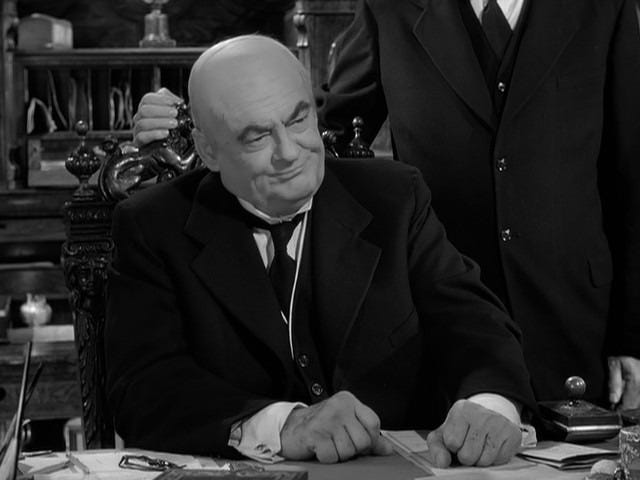
From Potter’s perspective (which is the prevailing perspective at every company you’ve ever worked at, as well as their regulators), agents responsible for other people’s investments ought to be impartial and procedural, and perform their fiduciary duty to maximize shareholder returns.
As seen through this lens, George Bailey is essentially a gangster, using other people’s money to hand out favors to his friends and build a personal patronage network.
The film clearly admires George for his leniency to debtors and disregard for profit, but that too is a way of acquiring personal influence at the shareholders’ expense.
A lot of people in Bedford Falls owe George Bailey a favor — and the heartwarming climax of the movie is when that favor is called in, and his friends receive him into everlasting habitations.
Of course, that’s a reference to the parable of the unjust steward, where a steward is about to be fired by his rich master for mismanaging his funds.
The steward says, “Well, I’m about to lose everything. I’m too weak to dig and too proud to beg. So here’s what I’ll do: I’ll go to everybody who owes my master money, and I’ll use my authority to drastically write down their debt — and then when I’m thrown out of the stewardship, I’ll have all these friends and they’ll take care of me.”
And that’s essentially what George Bailey is doing throughout the film: he’s using his authority over other people’s money to acquire influence.
Whether you think that’s appropriate behavior or not largely depends on whether you think of him as an employee who’s responsible to act in the interest of his employers (the investors) — or a king, responsible to act in the interest of his subjects.
From the film’s perspective, George Bailey is clearly the rightful heir to the throne of Bedford Falls, and it’s exactly his unaccountable sovereign power that allows him to save the realm.
You don’t hear about Building & Loan associations anymore because they required human trust, loyalty, and coordinated action.
Building & Loan Associations operated under a mutual membership structure, in which homeowners paid for their homes through “share accumulation”, in which a significant portion of the monthly payment was a purchase of shares in the B&L.
The value of your shares was based on the profitability of the association, and you were obligated to buy and hold your shares to maturity. A B&L depended on strong economic alignment — you need your neighborhood to stay financially healthy, so that all of your neighbors will keep making their payments and maintain the value of your share price.
This is what George Bailey means when he says “…The money’s not here. Your money’s in Joe’s house, right next to yours … you’re lending them the money to build, and then they’re going to pay it back to you as best they can. Now what are you going to do? Foreclose on them?”
Well, in the real world, in the Great Depression, they did foreclose on each other, and B&Ls largely collapsed, in favor of Savings & Loan Associations (S&Ls) with conventional mortgages as we now understand them (a strictly bilateral contract between the individual debtor and the bank).
So, instead of this complex, multivariate, human, relationship-based institution where you have a vested interest in the health of the community and vice versa, now you have a totally transactional, totally trustless, totally automated flow of capital to you as an individual.
If the bank’s algorithm says you get a loan, you get a loan. And if it says you don’t, you don’t. If you can make your payments, you keep your house. And if you can’t make your payments, it really doesn’t matter why — there’s no human being in the loop — you just get foreclosed on.
And in some ways we can say, well, I understand why that happened.
Maybe I don’t want to invest in my community. Maybe I don’t want the value of my home, my investment to be dependent on every schmuck on my street.
But the fact is, that dependency existed anyway. There are obvious political reasons we don’t talk about it; but millions and millions of Americans had their equity in their home effectively wiped out through white flight, block busting, and the collapse of America’s inner cities.
Now, of course, Frank Capra was himself an Italian immigrant, so he scrambles the messaging a little bit here. But by depicting the dichotomy between Bailey Park and Pottersville, he clearly shows what happens — what did happen — when people lose their common ownership in their communities.
The miracle of It’s a Wonderful Life is that George Bailey, by God’s grace, holds his people together through courage, sacrifice, and force of will.
When George stands up to Potter, he’s not standing up for infinite free houses for everyone in Bedford Falls — and, importantly, he’s not fighting for a communitarian, democratic, common-property thing, either.
George is fighting for his own personal right to decide who gets the loans that don’t make sense on paper, who gets a few extra months to make payments, etc. He wants the power to decide the exception.
Which is to say: Bailey and Potter are fighting for sovereignty over Bedford Falls — to decide who lives there, and in what sort of homes, and on what terms. They are explicitly struggling for personal power.
The most important question to ask of It’s a Wonderful Life is: why would a selfless, decent man like George Bailey struggle for personal power? And why would the people of Bedford Falls struggle and sacrifice to keep him in power?
Answer: because both George Bailey and the people recognize that his sovereignty is their sovereignty.
If George had refused to take on the Bailey Building and loan after his father’s death, it would’ve been dissolved — and, for lack of a binding institution, every member’s property would’ve been gobbled up piecemeal by Potter.
If George and his wife had not set an example of sacrifice during the bank run, giving away their honeymoon fund to keep the B&L solvent, even the most loyal and stalwart members of the B&L would’ve been cleaned out, and forced to sell their shares — probably for less than the 50% discount Potter initially offered.
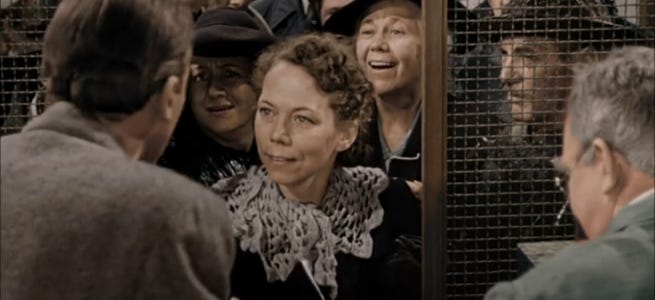
Without George Bailey as the sovereign, not only is loyalty and good faith not rewarded — it’s actively punished.
The holdouts, the people who stand and fight get the worst deal.
It matters very much that George Bailey has the power, the personal power, to cut all these informal human deals to prevent the bank from failing, and the personal magnetism to convince people to take less than they’re owed.
George’s sovereignty doesn’t compete with the members’ — it’s precisely because he is in charge that they are able to hold on to their own dominions
This is why the archetypal connection between the righteousness of the king and the health of the land is so resonant and intuitive.
People in our corner of Twitter are accustomed to thinking of our present algorithmic, headless, entropic state as a unique dysfunction of managerialism.
But it’s actually just the Law of the Jungle — the state of the land without a protector — and it’s one of the oldest stories there is.
It’s the story of the Book of Judges. It’s the story of the Fisher King in the Grail myth. It’s the story of post-colonial Africa. It’s the story of the Lion King.
In the alternate history of Bedford Falls in which no king emerges, power and sovereignty simply falls to the most cunning and dangerous predator (Potter). And Potter doesn’t actually want to rule Bedford falls in any meaningful sense. He just wants to eat it.
Potter is an agent of pure entropy, breaking down and extracting and consuming every competing node of power or value. (This is what Ben Shapiro likes about him: he’s efficient.) The strippers and vagrants in Pottersville are not the product of any affirmative human vision: they show up for the same reason crabgrass shows up in a neglected garden box.
That’s also the story of Judea under Roman rule — the Judea into which Christ was born.
The priests and scribes derive their authority from their interpretation of the dead law. They build the tombs of the dead prophets and stone the living ones. Why? Because the living prophets are around to defend themselves, to defend their words, to defend the Lord.
The words they left behind can’t defend themselves — and, of course, as we’ve learned so painfully over the last century, rule of law really means rule by lawyers.
So these lawyers, these priests, these scribes, these interpreters of the law, are enjoying the enormous benefits of the law’s infinite flexibility.
These are people who discovered the central insight of postmodernism, 2000 years early: “There is nothing outside the text.” The text does not supply its own interpretation.
Now, this is not to say that words don’t have value, but words are a communication between a person and another person. Your understanding of the word of God is wholly dependent on who you think God is — so the coming of Christ into the world is God saying, “Here I Am.” This is who I am.
He doesn’t come to abnegate the words of the prophets, or say that they’re not valid: he comes to assert his absolute sovereignty, his authority as the Lawgiver.
He doesn’t say the Sabbath doesn’t matter: he says, “the Son of Man is the Lord of the Sabbath.” When Jesus teaches in the temple, they marvel that he teaches “as one having authority, and not as the scribes.”
The state of Judea under the scribes and the Pharisees was one in which the kingdom, the sovereignty, the stewardship, had been usurped by parasites and predators.
When Simeon holds the baby Jesus in the temple, it says that he was looking for the consolation of Israel, their deliverance. That deliverance was the return of the true King: a Man, a righteous judge to judge Israel, in contrast to the predatory venality of the scribes and the Pharisees.
They’re tired of being preyed upon by the cleverest and most ruthless and best connected lawyers.
And that’s why the people want George Bailey to decide who lives in Bedford Falls and on what terms.
They want to be subject to a human judge and protector, executing a human vision, instead of the blind idiot god of entropy.
The desire to be subject to righteous human judgment — to kneel before a Good King — is not just the product of monkey instinct or propaganda. It solves all kinds of spiritual and practical problems.
Likewise, George doesn’t want power because he likes wielding it.
One of the most interesting scenes in the movie is when Potter totally correctly lays out George’s psychological situation: that he’s “trapped in this small town, frittering his life away, playing nursemaid to a lot of garlic-eaters.”
And it’s just so obviously true.
Power is not fun unless you’re crooked.
But George fights for his father’s throne because, if he doesn’t, the realm will come to ruin. It’s not (strictly) supernatural — things fall apart when they’re run by people who don’t give a shit.
Some friends have said that they never liked It’s a Wonderful Life because they understood it as a movie about giving up on your dreams and embracing the longhouse.
In the beginning of the film, George dreams of testing himself against the world as a knight-errant, and he is robbed of the opportunity by circumstance.
The war montage in which he fights “The Battle of Bedford Falls” is played as a joke, and the narrator describes him as merely “getting four years older”.
There’s a genuine element of tragedy in his being thrust too young into kingship — but that’s the sacrifice that sanctifies the real Battle of Bedford Falls.
It would be a longhouse movie, if George Bailey gave up adventure to be a clerk and obediently do his fiduciary duty — but it’s precisely his fight for unaccountable, personal power that makes him heroic.
If he had done what he was told, and followed the rules, and listened to the voice of the people — if there had been an empty suit at the head of the B&L — his home would have been destroyed.
George Bailey governs Bedford falls in the people’s interest, but not at the people’s pleasure.
The moral of It’s a Wonderful Life isn’t that placid domesticity is better than adventure — it’s that power is better than money, and good men should fight for it.
I mention this because it is exactly the distinction between genuine patriarchy and servile, “happy wife happy life” family-values conservatism, and this confusion gets in the way of a lot of young men pursuing the kind of power that they could win.
A lot of our guys feel that the struggle for space, the quest for sovereignty is fundamentally at odds with family life.
You’ll never hear us defend contemporary family norms, but your blood, and your close friends, and the people who know you personally really are the best place (if not the only place) to look for the kind of alignment and loyalty and cohesion that can actually lead to the accumulation of real power and real freedom — which, by the way, are synonymous.
There’s no English sentence in which you can talk about “freedom”, where “power” is not just as good a fit. The only type of “freedom” that doesn’t equate to power is permission.
In other words, you’re, you’re “free” to go to the bathroom if you have a hall pass because teacher says it’s okay.
But the freedom that we’re missing, the freedom that we crave, is power, and we want it for the same reason George Bailey wants it: so that we can rule well — so that the kingdom can be rightly ordered.
But as long as you believe that there’s some distinction, or some way to disentangle freedom, or duty, or responsibility from power, you’ll always be psychologically weakened.
You’ll always be double-minded (particularly if you’re a Christian) — because you will always have this nagging feeling that you’re doing something impure, and therefore you can’t be entitled to providence — you can’t be entitled to divine help — because you’re seeking “power” (in other words, seeking responsibility, seeking freedom, seeking stewardship.)
That above all is the story of our predicament: the righteous man — the man capable of judgment, capable of stewardship — has abdicated his responsibility to rule; maybe out of humility, maybe for less noble reasons. But in any case, now we’re ruled by people who don’t have those compunctions.
You live in Pottersville today because there was no George Bailey.
To the extent that our managerial system is worse than other historical forms of misrule, it’s because it actually moralizes procedural anarchy. Not only is there no human judgment, no human bonds of loyalty, no human order — but there ought not to be, and anyone who tries to create such an order is both a moral and political criminal.
Everything has to be governed by an abstract ideological algorithm so that it’s “fair”, so that it’s “impartial”. If you give your son a job opportunity rather than an Indian who can do it for cheaper, you’re not just being inefficient, you’re being corrupt — maybe even racist. Everyone has to be treated exactly the same.
And of course, no human can do that. So we all have to live like machines and be chopped to fit — and it’s almost impossible to overstate how sincerely this moral worldview is held. The average Westerner raised by the television really does believe that loyalty is a vice — that anyone who’s a good person, algorithmically defined, should be someone that you help, and anyone who’s a bad person, algorithmically defined, should be someone that you have no connection to.
They really believe that Pottersville is freedom because you’re free to be an alcoholic, you’re free to be a vagrant, you’re free to be a prostitute. Pottersville is the product of a million freely chosen individual transactions.
And seeking personal human power is immoral, because personal power can only be exercised immorally. It can only be used to decide exceptions — in other words, to be partial, to exhibit particularity, to exhibit bias, to prefer or to disfavor on the basis of something other than The Rules.
And it’s certainly not an accident that this movie, which has so much to teach us about our present moment, was produced by a Sicilian immigrant, who was raised in that thoroughly pre managerial, pre-modern personal worldview.
(You could do a very deep meditation on The Godfather for similar reasons.)
Now, obviously, we may say that foreigners with those tribal sensibilities are sand in the gears of our way of life — but it’s just dead obvious, at least to me, that all our “managerial virtues”, these liberal virtues (if you want to call them that) are designed for a technological and social environment that just doesn’t exist anymore.
The future will be a return to form, where politics, security, economics, and even epistemology are rapidly receding from this massive high point of centralization.
And I don’t really have it in me to mourn that loss.
So in this new paradigm, the peoples that never went through that ordeal of civility — that never acquired those managerial virtues — are just way, way more adaptive. So even societies that are wildly dysfunctional and antisocial, if they have this internal cohesion, this sense of us, they’re able to just run circles around all these bureaucratic managerial systems.
And so it’s not to say that we need to learn to be as dysfunctional and antisocial as Somalis, or even Sicilians. But we are going to have to figure out how to hang together, and cooperate, and make personal human judgements, human decisions, in ways that pre managerial peoples never forgot how to do.
And George Bailey represents that synthesis.
He’s conscientious, he’s ambitious, he’s productive, he’s pro-social: he’s an Anglo who has unlearned managerialism.
But in our world, we weren’t that lucky. No human power emerged to defend the “common wealth”, the reciprocal bonds of loyalty, the shared sovereignty represented by the Bailey Building & Loan. We were left to fight the vast, impersonal cultural and economic forces that threatened our families and property alone.
And here we are.
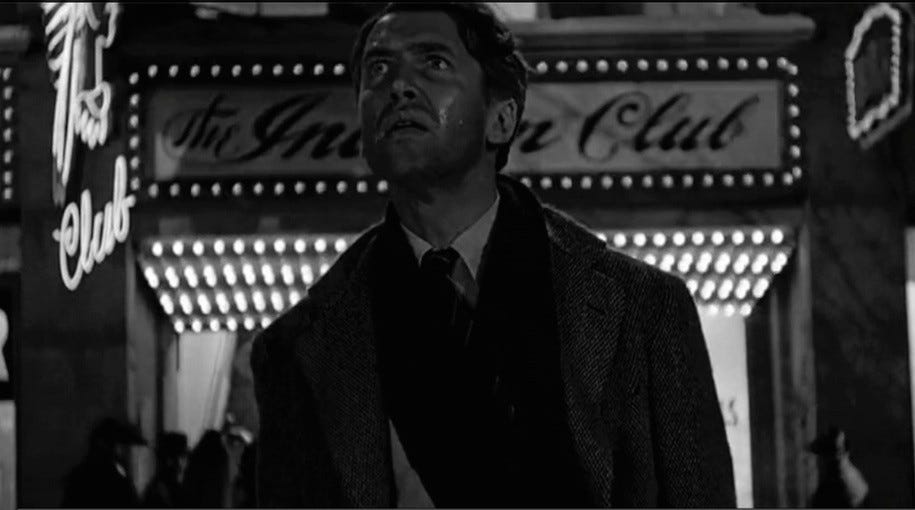
It’s a Wonderful Life is a Christmas movie because all stories about The Good King are stories about Christ.
George Bailey has to pour himself out over a lifetime to win the trust of a skittish, short-sighted people. And, critically, it’s not just his business dealings with them.
The town has gotten to know him through his whole lifetime of being groomed, both morally and intellectually, as the heir to the throne.
It matters enormously that George saved Mr. Gower, and saved his brother — and that, even as a child, he defended his dad’s honor and the Building & Loan against Mr. Potter, right to his face, in front of the board of directors.
It’s not just that people trust him as a capable administrator, or they view him as a shelling point for a coordination problem.
They have to believe in him as a good man because — critically — giving him sovereignty means giving him the power to betray them.
The whole point is that he’s not a clerk. They’re willfully and purposely surrendering the right to oversee and audit and judge his decision making. This arrangement does not work unless they do that.
It’s not a happenstance that his behavior would be considered criminal by modern standards. It’s exactly its extrajudiciality, its criminality, that makes it work.
Our system is failing precisely because it has made that kind of human judgment and discretion against the law.
Bailey’s personal virtue and sacrifice is what makes it possible for the people to credibly unite behind him and make their own sacrifices, to take up their own cross — which they desperately want to do, because it’s the only way they can resist the malevolent, inhuman powers that threaten them.
The Christmas miracle is the return of the King who will set things right, and judge us with compassion.
(To be judged with compassion is not to be infinitely indulged.) It’s a miracle because it is the defeat of the entropy that would otherwise be inevitable — the indifferent Law that would judge us to our destruction.
The turning point of human history is God revealing himself, not as an impersonal force or energy or law, but as a Man — with a man’s heart and judgment and particular love.
Exit is a fraternity dedicated to shorting managerial systems and building the human institutions that come next.
We believe that these managerial systems, in addition to being ugly and anti-human, are in the process of collapse.
The institutions that replace them, as the locus of social and political identity, will be much closer to the psychological roots of human connection: what we call the feudal instinct.
Basically, we believe in the return of the family as the fundamental unit of human society.
Like I said, I personally got a lot out of the feedback from this post last year. I’d love to hear your thoughts on this below.
Also, please subscribe to the weekly newsletter where we develop ideas like these, and I also post the week’s news for the group.
If you’re a paid subscriber to the Substack, you get access to the full recordings of our member Q&As, as well as invites to our in-person cocktail hours.
If you’d like to apply for full Exit membership, and get access to our 15-20 weekly group calls, monthly meetups in over a dozen cities, and the opportunity to network and collaborate on internal projects with the guys, you can apply for membership at exitgroup.us.


