


I hear a lot of reasons why nothing can be done.
The Republican Party is useless
The structure of modern politics inherently favors our enemies
The only actions available are immoral
The only actions available will land us in jail
It’s too late to do anything (demographic change is irreversible, the libtards closed the doors to infiltration behind them)
It’s too early to do anything (the boomers need to die, things need to get worse, etc.)
We can’t emulate historical winners because our problems are too different
We can’t emulate historical winners because they were just the libtards of their time, coasting on the currents of inevitable libtard victory
EXIT is a fraternity dedicated to shorting managerial systems and building the human institutions that come next. Learn more here:
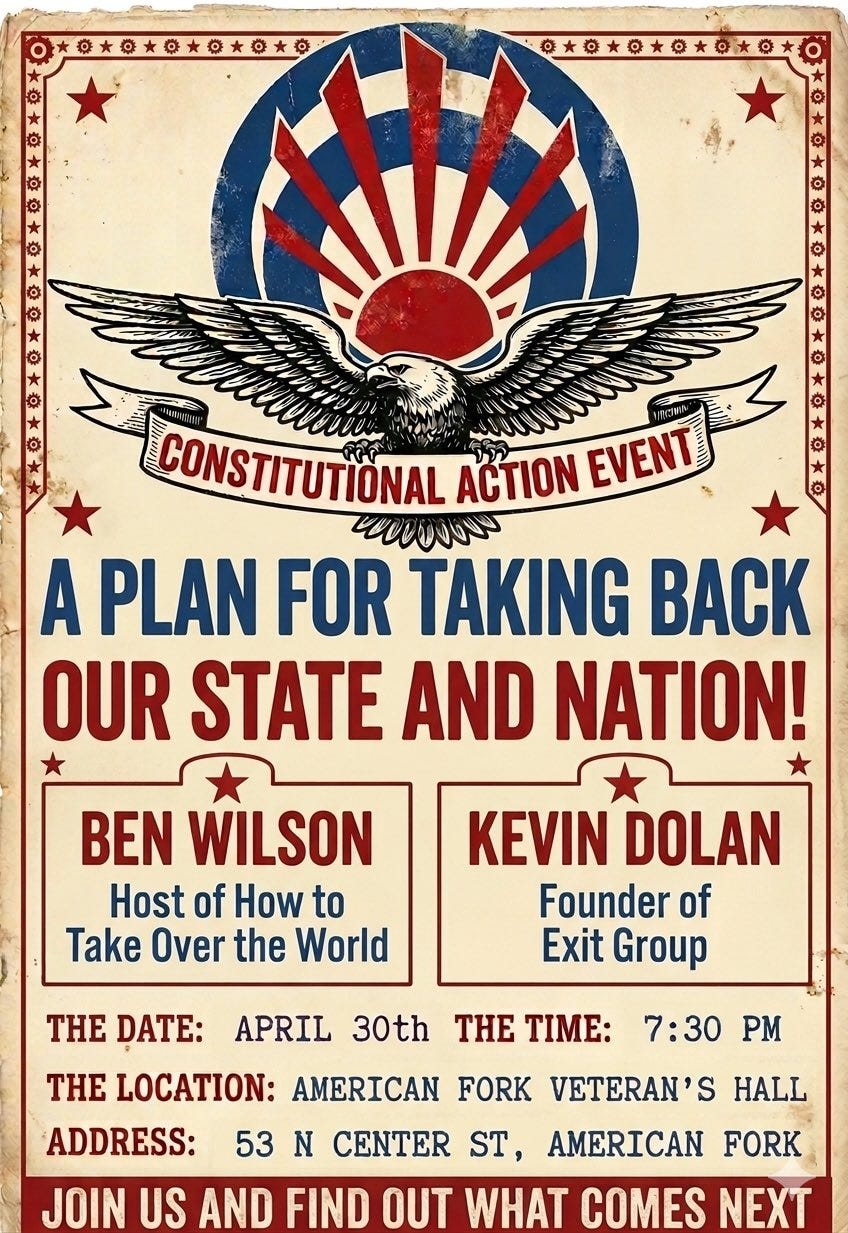
Next week in Utah, we’re going to explain why all of that is nonsense.
We’re going to lay out the history of movements that successfully defeated and supplanted modern managerial regimes, under conditions that were, in many ways, more challenging than our own:
Heavier state surveillance
More totalizing narrative control
Fewer practical constraints on official power
Their political and legal systems were far more fake
Prospects of extralegal resistance were even less favorable
We’ll discuss some “good guy” cases that are cleanly exemplary (Czech anticommunists, the Polish Solidarity movement, the Founding Fathers), as well as a few “bad guy” cases from which we should take narrower lessons — but what all these movements have in common is this:
They contested the state’s legitimacy long before they contested its sovereignty.
By this we do not just mean that they critiqued the state’s actions (though exposing the managerial state’s corruption and hypocrisy and ill will is part of dismantling it, for reasons that we will explain.)
These movements contested the state’s legitimacy by picking up responsibilities that have been abdicated, starting in the domain of “civil society”: clinics, schools, media and publishing, youth groups, trade unions, volunteer emergency response, etc.
All things that “good citizens” were in theory permitted — in fact, in theory, encouraged — to do.
We will describe how these movements’ (by definition) legal, lawful, and popular actions earned them a deep reserve of credibility and goodwill with the people.
This “reserve account” made the movement increasingly difficult to target, even as they became obvious competitors with the state, openly taking on responsibilities that the state claimed to provide for the citizens, but that it did corruptly, ineffectively, or not at all in practice:
dispute resolution
shadow land recording
parallel credentialing
election monitoring
illegible finance, etc.
In the cleanest and best cases, the contest for sovereignty only began in earnest (with the revolutionary movement assuming military and law enforcement functions) when the contest for legitimacy was already over.
As the incumbent regime decayed, the new movement built legitimacy brick-by-brick, taking over more and more basic functions — until one day, the movement was simply The Government, and its enemies were the rebels, unable to reconquer a population that now viewed them as foreign, hostile, and criminal.
Dozens of successful movements have followed this basic pattern, and nothing about our technological or political situation suggests that the pattern has changed.
In fact, we will discuss in detail just how precisely the 20th-century anticommunists’ diagnosis mirrored our own, what they did about it, and why they succeeded.
We will identify what is new and different from the historical cases: we face (solvable) challenges that the historical victors did not face — but also opportunities that they could not have imagined.
We will demonstrate that our enemies are not historically unique, either in their power or their wickedness — and overcoming them will require neither impossible virtue, nor a willingness to lose one’s soul.
It will require ordinary, decent people to show up.
If you are in Utah, sign up to join us here:
We will invite in-person attendees to join Constitutional Action, and volunteer for beautification and door-knocking activities in May.
The event will also be recorded and made available to subscribers.
Below the paywall, invites for EXIT subscriber cocktail hours in:
Chattanooga, TN (4/24)
Washington, DC (5/16)
New York, NY (5/18)
Boston, MA (5/19)
San Francisco (6/5)
Denver (6/27)
